
Your Professional North America Series Booster Cables Manufacturer
Zhejiang Safemate Automotive Safety & Emergency Technology Co,. Ltd. is a professional enterprise specializing in auto emergency products ,with over 20 years experience. Professional marketing analysis,strong assortment ability and customize design keep us a leading manufacture in worldwide car emergency business.
-
![SAE-10GA]() SAE-10GAItem: Booster Cable 10GASpec: 0.33*55CCA (4.65mm2)*7.5mmMaterial: CCA, PVC-42℃Clamp: A16 copper plated clamp
SAE-10GAItem: Booster Cable 10GASpec: 0.33*55CCA (4.65mm2)*7.5mmMaterial: CCA, PVC-42℃Clamp: A16 copper plated clamp -
![SAE-8GA]() SAE-8GAItem: Booster Cable 8GASpec: 0.33*85CCA (7.23mm2)*8mmMaterial: CCA, PVC-42℃Clamp: A07 copper plated clamp
SAE-8GAItem: Booster Cable 8GASpec: 0.33*85CCA (7.23mm2)*8mmMaterial: CCA, PVC-42℃Clamp: A07 copper plated clamp -
![SAE-6GA]() SAE-6GAItem: Booster Cable 6GASpec: 0.33*140CCA (12.1mm2)*9mmMaterial: CCA, PVC-42℃Clamp: B03-2 insulated clamp
SAE-6GAItem: Booster Cable 6GASpec: 0.33*140CCA (12.1mm2)*9mmMaterial: CCA, PVC-42℃Clamp: B03-2 insulated clamp -
![SAE-4GA]() SAE-4GAItem: Booster Cable 4GASpec: 0.33*215CCA (18.3mm2)*9.5mmMaterial: CCA, PVC-25℃Clamp: B03-2 insulated clamp
SAE-4GAItem: Booster Cable 4GASpec: 0.33*215CCA (18.3mm2)*9.5mmMaterial: CCA, PVC-25℃Clamp: B03-2 insulated clamp -
![SAE-2GA]() SAE-2GAItem: Booster Cable 2GASpec: 0.33*365CCA (31.1mm2)*11.5mmMaterial: CCA, PVC-25℃Clamp: B25 insulated clamp
SAE-2GAItem: Booster Cable 2GASpec: 0.33*365CCA (31.1mm2)*11.5mmMaterial: CCA, PVC-25℃Clamp: B25 insulated clamp -
![SAE-1GA]() SAE-1GAItem: Booster Cable 1GASpec: 0.33*445CCA (38.1mm2)*12mmMaterial: CCA, PVC-42℃Clamp: A21-4 heavy duty clamp
SAE-1GAItem: Booster Cable 1GASpec: 0.33*445CCA (38.1mm2)*12mmMaterial: CCA, PVC-42℃Clamp: A21-4 heavy duty clamp -
![SAE-1-0GA]() SAE-1-0GAItem: Booster Cable 1/0GASpec: 0.33*560CCA (48.1mm2)*13mmMaterial: CCA, PVC-42℃Clamp: A30 heavy duty clamp
SAE-1-0GAItem: Booster Cable 1/0GASpec: 0.33*560CCA (48.1mm2)*13mmMaterial: CCA, PVC-42℃Clamp: A30 heavy duty clamp -
![UL-B21]() UL-B21Spec: 4-8GALength:12-25FTMaterial: CCA/Copper, PVC-25℃Clamp: B21 insulated clampBooster Cable with UL Certifiation
UL-B21Spec: 4-8GALength:12-25FTMaterial: CCA/Copper, PVC-25℃Clamp: B21 insulated clampBooster Cable with UL Certifiation -
![UL-B25]() UL-B25Spec: 1-10GALength:12-30FTMaterial: CCA, PVC-25℃Clamp: B25L insulated clampShort Description: Booster Cable with UL Certifiation
UL-B25Spec: 1-10GALength:12-30FTMaterial: CCA, PVC-25℃Clamp: B25L insulated clampShort Description: Booster Cable with UL Certifiation


Why Choose Us
High Quality
Specialized on car emergency tools industry over 20 years, strict quality control and factory management win customer’s trust. Factory is certified ISO9001:2015,ISO14001:2015 and BSCI.
Safety
Your safety is our top priority. All products are tested when mass production and with safety certification according to different market requirement, GS,UL,CE,ETL,ROHS,PAHS,REACH and so on.
Professional Team
Great design and development team provide perfect support on new product development and package design. We can make OEM/ODM and package design for all customers.
24H Online Service
Our dedicated customer service team is available 24/7 to answer any questions and provide support.
Types of North America Series
The North America Series produced by our company mainly include the following types:
Booster Cable with UL Certifiation
A booster cable with UL certification is a battery jumper cable that has been tested and certified by Underwriters Laboratories (UL) to meet specific safety standards. This certification indicates that the cable and its components, including the clamps and insulation, have been evaluated for electrical safety, fire resistance, and performance in various conditions.
|
Product description: Professional booster cable with UL certification,High-quality and more secure |
|||||
|
Material |
Spec(Ga) |
Lenght(Ft) |
Current(A) |
Temp Rating(C) |
Certification |
|
CCA |
8 |
12 |
200 |
-25 |
UL Listed |
|
CCA |
8 |
14 |
145 |
-25 |
UL Listed |
|
CCA |
8 |
16 |
130 |
-25 |
UL Listed |
|
CCA |
6 |
12 |
240 |
-25 |
UL Listed |
|
CCA |
6 |
14 |
190 |
-25 |
UL Listed |
|
CCA |
6 |
16 |
175 |
-25 |
UL Listed |
|
CCA |
6 |
20 |
160 |
-25 |
UL Listed |
|
CCA |
4 |
12 |
350 |
-25 |
UL Listed |
|
CCA |
4 |
16 |
295 |
-25 |
UL Listed |
|
CCA |
4 |
20 |
250 |
-25 |
UL Listed |
|
CCA |
4 |
25 |
200 |
-25 |
UL Listed |
|
Copper |
4 |
16 |
450 |
-25 |
UL Listed |
|
Copper |
4 |
20 |
440 |
-25 |
UL Listed |
|
Copper |
4 |
25 |
340 |
-25 |
UL Listed |
Booster Cable with SAE standard
A booster cable adhering to the SAE (Society of Automotive Engineers) standard is a set of jumper cables designed for temporarily connecting a surface vehicle battery to another to provide emergency power. These cables must meet minimum performance and user information requirements outlined in the standard.
|
Product description: Professional booster cable comply with SAE standard, economical, durable and safe |
||||
|
Material |
Spec(Ga) |
Lenght(Ft) |
Current(A) |
Clamps |
|
CCA |
1 |
20 |
410 |
A21-4 |
|
CCA |
1 |
25 |
380 |
A21-4 |
|
CCA |
1 |
30 |
330 |
A21-4 |
Advantages of Booster Cable with UL Certifiation
Safe & Durable
UL-certified booster cables are made by refined coppery which is very durable. Patented design clamps covered with non-conducting rubber, it is safe enough for repeatedly use.
UL Certified
Every booster cables passed the strict working temperature test which is up to the UL standard, it works well in the extreme environment(-40℉~ 140℉).
Versatile Compatibility
These booster cables are versatile, suitable for cars, SUVs, and trucks, making them a reliable toolkit essential for any driver looking to address jump-start needs confidently and efficiently.
Reduced Risk of Accidents
UL certification means the cables have been tested for electrical safety, minimizing the risk of short circuits, fires, and other electrical hazards during jump-starting.
Advantages of Booster Cable with SAE Standard
Ensure Quality and Reliability
SAE standards provide specific criteria for the design, testing, and functionality of boost cables.
Safety
SAE standards prioritize safety and place rigorous evaluations on components like boost cables. This helps ensure that the cables are designed to minimize the risk of overheating, shorting, or damage during use.
Proper Cable Specifications
SAE standards specify the wire gauge (thickness), length, and current rating of booster cables to handle the required current. Thicker wire gauges (smaller wire gauges) can carry more current and reduce voltage drop, ensuring efficient power transfer for fast starts.
Durability and Lifespan
Cables that meet SAE standards are typically made with high-quality materials, such as pure copper conductors and strong insulation. This construction enhances the cable's durability and resistance to environmental factors such as wear and tear, as well as extreme temperatures.
Compatibility
Booster cables are generally compatible between different vehicles as long as the voltage systems match and the clamps fit the terminals, and SAE standards ensure that the cables are built to common specifications, increasing the likelihood of compatibility and effective operation in a variety of situations.
Reduced Risk of Damage
By adhering to specifications regarding wire gauge, insulation, and connector quality, SAE compliant cables minimize the risk of overheating, short-circuiting, and damage to the vehicle's electrical system during the jump-starting process.
Step-by-Step Guide to Using Booster Cables


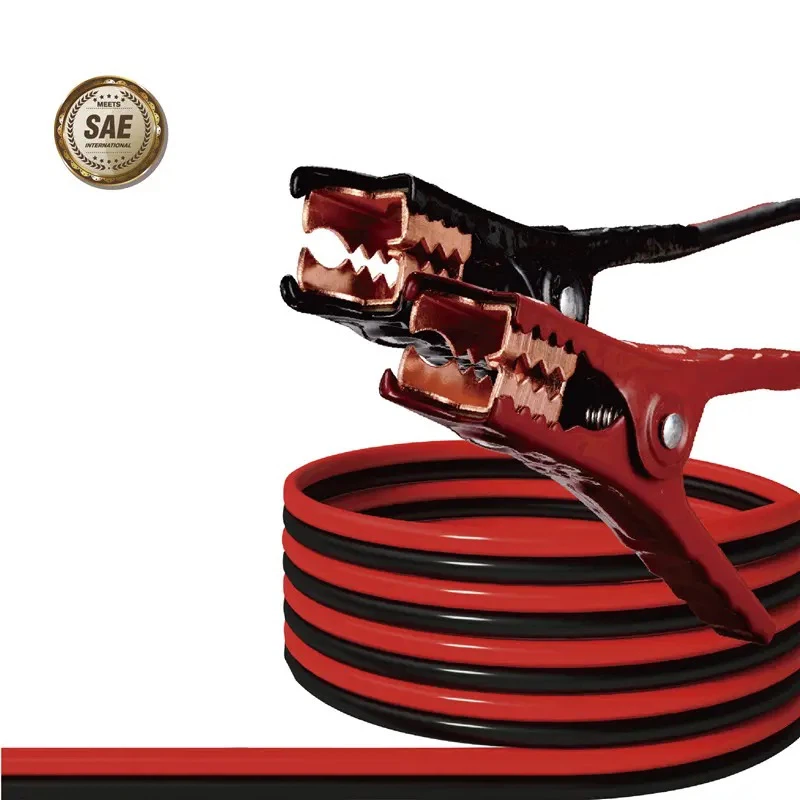
Position Vehicles Safely
Ensure both vehicles are in Park (automatic) or Neutral (manual), and apply the parking brake. Turn off both engines completely. Make sure the booster cables can reach between both batteries without being stretched or kinked.
Inspect Battery Condition
Before proceeding, visually inspect both batteries. If there is visible corrosion, leakage, or physical damage, do not attempt to jump-start the vehicle. Replace the battery first if necessary.
Identify Battery Terminals
Locate the positive (+) and negative (-) terminals on both batteries. These are typically marked clearly, often with red covers for positive and black for negative. Ensure the clamps will make good contact by cleaning any corrosion with a wire brush if needed.
Connect Red Cable to Live Battery
Attach one red clamp to the positive terminal of the working battery. Make sure it is secure and does not touch any other metal surface. This prevents accidental short circuits.
Connect Other Red Clamp to Dead Battery
Now connect the other red clamp to the positive terminal of the dead battery. Again, ensure a firm connection and keep the black clamps away from any metal surfaces at this stage.
Ground the System with Black Cable
Attach one black clamp to the negative terminal of the live battery. Then, connect the remaining black clamp to an unpainted metal part of the car with the dead battery—such as a bolt or bracket—to serve as a ground. Avoid connecting directly to the dead battery to prevent potential sparks near hydrogen gas emissions.
Start the Working Vehicle
Turn on the engine of the vehicle with the live battery and let it run for a few minutes. This helps charge the dead battery slightly before attempting to start it.
Attempt to Start the Dead Vehicle
Try starting the vehicle with the dead battery. If it doesn’t start immediately, wait a minute and try again. If unsuccessful after several attempts, stop and check connections or consider charging the battery directly instead.
Disconnect Cables Safely
Once the dead vehicle starts, disconnect the cables in the reverse order: remove the black clamp from the grounded metal first, then from the live battery. Then remove the red clamps starting with the previously dead battery, followed by the live one.
Packaging and Shipping

FAQ
Popular Products